
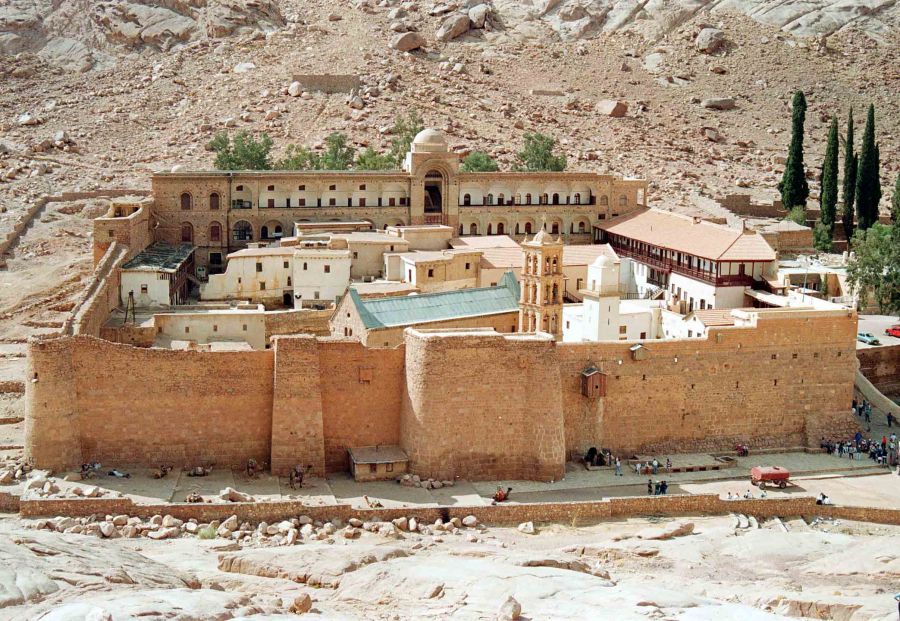
A court decision in Egypt transferring ownership of lands surrounding the historic Saint Catherine's Monastery to the Egyptian state has sparked a diplomatic crisis with Greece, drawing fierce backlash from church leaders and political parties in Athens and raising concerns over the future of one of Christianity's oldest and most revered monastic sites.
A full-blown diplomatic fever has been triggered between Athens and Cairo following a controversial ruling by an Egyptian appeals court over the ownership status of lands surrounding the historic Monastery of Saint Catherine in Sinai. The Greek government, led by Prime Minister Kyriakos Mitsotakis, finds itself in a politically precarious position, with mounting domestic and international pressure. The Greek Ministry of Foreign Affairs, caught off guard by Egypt's unilateral legal maneuver, is now racing to contain the fallout, amid accusations of complacency and miscalculation.
At the heart of the controversy lies one of the world's oldest functioning Christian monasteries, nestled at the foot of Mount Sinai. Revered by millions and protected as a UNESCO World Heritage Site, the Monastery of Saint Catherine has been a beacon of Eastern Orthodox Christianity and a symbol of religious coexistence for nearly 1,500 years. Now, a court ruling has transferred legal ownership of the monastery's surrounding properties to the Egyptian state, sparking a firestorm of condemnation from church authorities, political parties in Greece, and religious communities worldwide.
The Ismailia Court of Appeals ruled that the monastery had no legal claim to the disputed lands, citing the absence of official ownership documentation. Although the court reaffirmed the monks' right to continue their religious practices within the core sacred precincts, it determined that all associated lands are state-owned and fall under national heritage protection laws. The ruling, based on a 1974 decree and Egypt's antiquities legislation, effectively prohibits privatization or exclusive religious control of the area.
Egyptian authorities, for their part, have emphasized that the ruling aims to preserve the cultural and archaeological integrity of the site. Dr. Abdel Rahim Rihan, a prominent Egyptian archaeologist affiliated with the Ministry of Culture, claimed the decision would enhance protection of the monastery and allow for improved conservation efforts. He argued that the involvement of the state is not an act of aggression against the Church but a step toward greater international visibility and sustainable tourism.
But these justifications have found little resonance in Greece. The Orthodox Church sees the decision as nothing short of a strategic expropriation. Archbishop Ieronymos of Athens and All Greece issued a blistering statement accusing the Egyptian government of acting in bad faith, stating that it had "abolished every notion of justice" and was attempting to "erase the very existence of the monastery." Describing the move as a "historic seizure," he called on international and ecclesiastical institutions to intervene urgently.
What has most stung Greek officials is the timing—and the perceived duplicity. Just weeks ago, Egyptian President Abdel Fattah el-Sisi visited Athens and met with Prime Minister Mitsotakis, where the two leaders jointly reaffirmed their commitment to preserving the religious character and operational integrity of Saint Catherine's. In a joint press conference, Sisi dismissed "false rumors" of state interference in monastic affairs, and the two countries pledged to deepen cooperation in cultural and religious heritage preservation.
Now, with the court ruling issued and Egypt moving forward with implementation, those assurances appear hollow. The Greek Foreign Ministry has issued a restrained yet pointed response, expressing "expectation" that Cairo will adhere to the spirit of the understandings reached during Sisi's visit. Foreign Minister Giorgos Gerapetritis reportedly contacted his Egyptian counterpart to seek clarification, though no formal Egyptian statement has yet addressed the ruling's implications for Greek-Egyptian diplomatic ties.
Domestically, the political backlash has been fierce. Opposition leader Antonis Samaras accused the Mitsotakis government of "international passivity" and warned of the "devastating symbolic loss" represented by the monastery's effective demotion from religious sanctuary to state-controlled heritage site. He called the ruling "unbelievable" and urged immediate international mobilization to protect what he termed "the spiritual lighthouse of Orthodoxy and Hellenism."
PASOK leader Nikos Androulakis joined the chorus of criticism, charging that the Greek government had failed to anticipate Egypt's legal maneuvers and had shown "a troubling lack of preparedness" on a sensitive religious and diplomatic issue. The SYRIZA party likewise condemned the Mitsotakis administration, alleging that the affair demonstrated "a reckless approach to the country's international relations and its commitments to Orthodox heritage."
Even within government ranks, concern is rising. Government spokesperson Pavlos Marinakis reiterated that Greece "does not anticipate any deviation from the commitments made," but admitted that a full evaluation of the Egyptian court's decision is still pending. He stressed that Prime Minister Mitsotakis remains personally invested in preserving the monastery's religious character and expects Egypt to honor bilateral agreements.
Meanwhile, church officials in Sinai are reportedly weighing an international campaign to raise awareness of what they call a violation of fundamental religious freedoms. Monks have rejected the narrative that the ruling benefits preservation efforts and fear that Egypt ultimately intends to convert the monastery into a state-run tourist attraction, with access to parts of the site subject to state approval.
from Όλες Οι Ειδήσεις - Dnews https://ift.tt/gcOjyRd
via IFTTT