

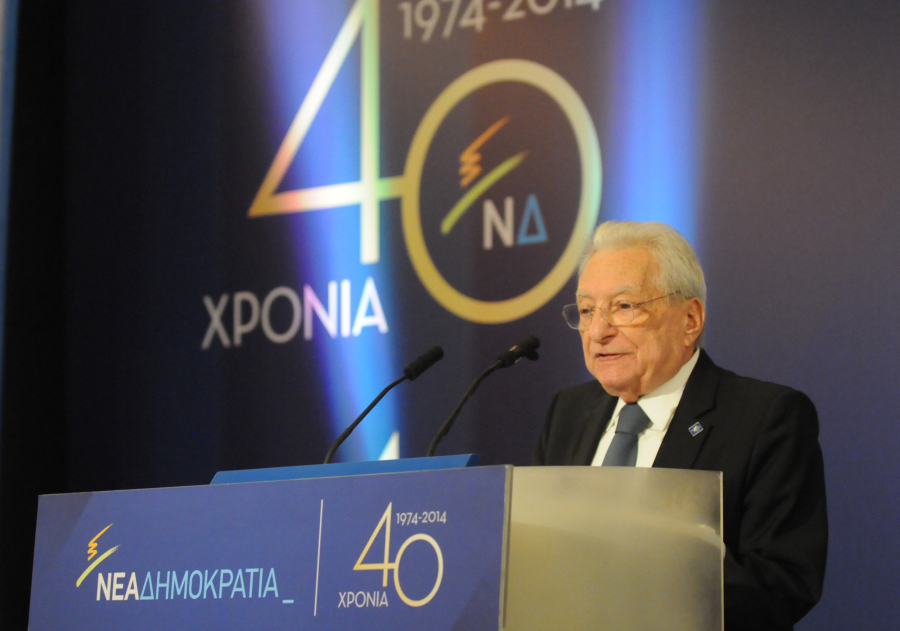
His long and respected diplomatic career coincided with some of the most turbulent moments of the Cold War and the shifting geopolitical landscape of the Balkans, allowing him to develop deep expertise in international relations and European affairs.
Petros Molyviatis, one of the most influential figures in modern Greek diplomacy and politics, passed away at the age of 97. His death marks the end of an era for Greek public life, in which he played a defining role for over half a century—both as a seasoned diplomat and a statesman deeply intertwined with the country's post-war history.
Born on the island of Chios on June 12, 1928, Molyviatis studied law at the University of Athens before entering Greece's diplomatic service. Over the years, he held key postings in Greek embassies in Moscow, Ankara, and Pretoria, as well as in Greece's permanent delegations to the United Nations in New York and NATO in Brussels. His long and respected diplomatic career coincided with some of the most turbulent moments of the Cold War and the shifting geopolitical landscape of the Balkans, allowing him to develop deep expertise in international relations and European affairs.
Molyviatis's name is closely associated with Konstantinos Karamanlis, the towering figure of post-war Greek politics and a founding father of the modern Greek center-right. A close and trusted advisor, Molyviatis served as Karamanlis's chief aide and director of his political office during both his premiership and presidency, from 1974 to 1980—a period that included Greece's transition to democracy after the fall of the military dictatorship. He was widely regarded as one of the most discreet yet influential operators behind the scenes, helping to shape Greece's European path and stabilize its democratic institutions.
In the decades that followed, Molyviatis remained an important presence in Greek politics. He served twice as Secretary General of the Presidency of the Republic, from 1980 to 1985 and again from 1990 to 1995, underlining the continuity and trust he commanded across political cycles. Entering the political arena more directly, he was elected to the Greek Parliament in 1996 as an at-large member for New Democracy and remained in the role until 2004.
That year, he was appointed Minister of Foreign Affairs in the first government of Kostas Karamanlis, the nephew of his long-time mentor. His tenure at the foreign ministry was marked by delicate regional diplomacy, especially surrounding the long-standing dispute with the Former Yugoslav Republic of Macedonia over its name. In 2005, Molyviatis co-signed a diplomatic initiative with Prime Minister Karamanlis, proposing a compromise to international leaders, including then-U.S. President George W. Bush. The Greek proposal suggested adopting a dual-name formula—"Republic of Macedonia–Skopje" for international use—while allowing the neighboring country to retain its constitutional name domestically. Although the issue would remain unresolved for more than a decade, the proposal illustrated Molyviatis's pragmatic approach to diplomacy, grounded in realism and national interest.
Remarkably, even in his later years, Molyviatis was called upon to serve his country. He was appointed foreign minister in two caretaker governments, first in 2012 and again in 2015, a rare honor that testified to the widespread respect he commanded across the political spectrum. His reputation for moderation and competence made him a trusted choice in times of institutional uncertainty.
Though a lifelong figure of the center-right, Molyviatis maintained relationships across party lines. Notably, he worked closely with Antonis Livanis, a senior aide to Socialist leader Andreas Papandreou, during the politically sensitive cohabitation period of the early 1980s. Together, they helped defuse potential crises between the presidency and government—further proof of Molyviatis's commitment to national stability over partisan gain.
He also served as president of the Konstantinos G. Karamanlis Foundation, which preserves the legacy of the leader with whom his own career was so closely intertwined.
from Όλες Οι Ειδήσεις - Dnews https://ift.tt/Jj5fcQ9
via IFTTT