
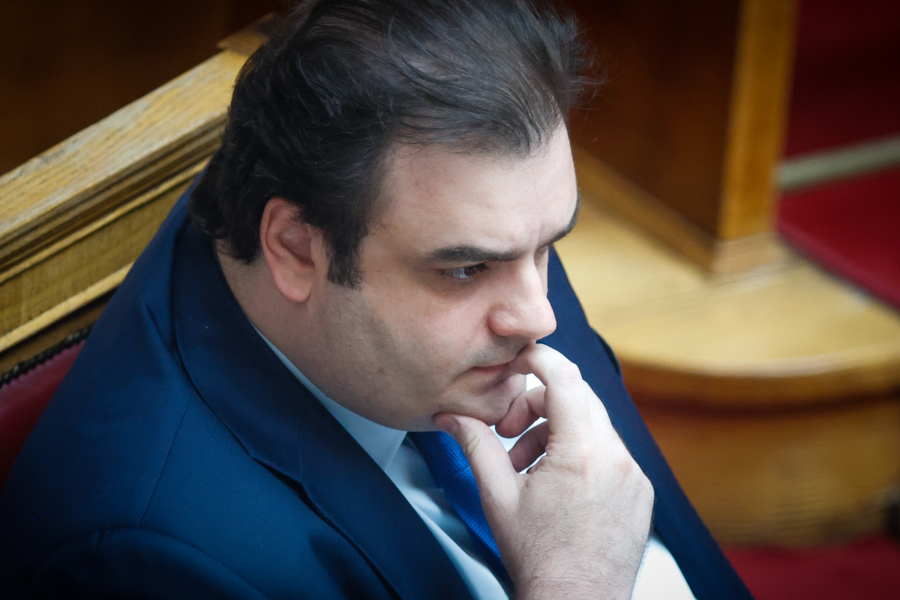
Greece's Minister of National Economy and Finance, Kyriakos Pierrakakis, described his country as "a success story built on the resilience of its people" during an interview in Washington, on the sidelines of the International Monetary Fund's annual meetings.
Speaking to ERT correspondent Lena Argyri, Pierrakakis outlined how Greece, after years of crisis and upheaval, has regained credibility and emerged as a model of stability and growth within the European Union.
He emphasized that Greece is now regarded internationally as a success case, a perception reflected in the performance of Greek bonds, which are faring better than those of major European economies such as France and Italy. "We have resolved our fundamental fiscal problem," Pierrakakis said, noting that Greece is producing primary surpluses and steadily reducing its public debt. "By 2026, it will stand at 137.6% of GDP, down from 210% just a few years ago." He added that growth is expected to reach 2.4%—twice the European average.
While the IMF's forecasts remain more conservative, Pierrakakis expressed confidence that they will be revised upward, as has often happened in the past. "The Greek economy has consistently outperformed expectations," he said, adding that he is optimistic the country will meet its 2.4% growth target.
The minister also acknowledged the challenges that persist, particularly Greece's demographic decline. He said the government's recently announced tax reform—introduced at the Thessaloniki International Fair—has a strong demographic focus, offering support for families, young people, and regional communities. "We have reduced 83 taxes and contributions over the past six years, but we must go further so that growth reaches every Greek household," he added.
On the investment front, Pierrakakis highlighted Greece's strategy to encourage more cross-border mergers and acquisitions, aligning with recommendations from European reports by Mario Draghi and Enrico Letta that call for removing barriers to intra-European business. He cited recent developments such as Euronext's proposed acquisition of the Athens Stock Exchange, Unicredit's investment in Alpha Bank, and CrediaBank's acquisition of HSBC Malta. "Our approach is one of openness," he said, stressing the importance of attracting investment in infrastructure and energy.
Pierrakakis noted that Greece is gradually transforming its economic model. "When we took office, investments accounted for 11% of GDP; today they exceed 15%, and we aim for 18% by 2026," he said, describing this trajectory as a "profound change in the structure of the economy."
Looking beyond Greece, he urged the European Union to accelerate progress toward a Capital Markets Union. "Europe must move faster," he said, calling for a single market free of internal barriers to foster the rise of "European—not national—champions."
Concluding his remarks, Pierrakakis underscored Greece's fiscal discipline and commitment to debt reduction. "We are repaying the loans from the first bailout ten years ahead of schedule," he said. "This generation will not pass the bill to the next." He argued that this fiscal responsibility forms the foundation upon which Greece is building a new economic era.
from Όλες Οι Ειδήσεις - Dnews https://ift.tt/lEm2cSp
via IFTTT