
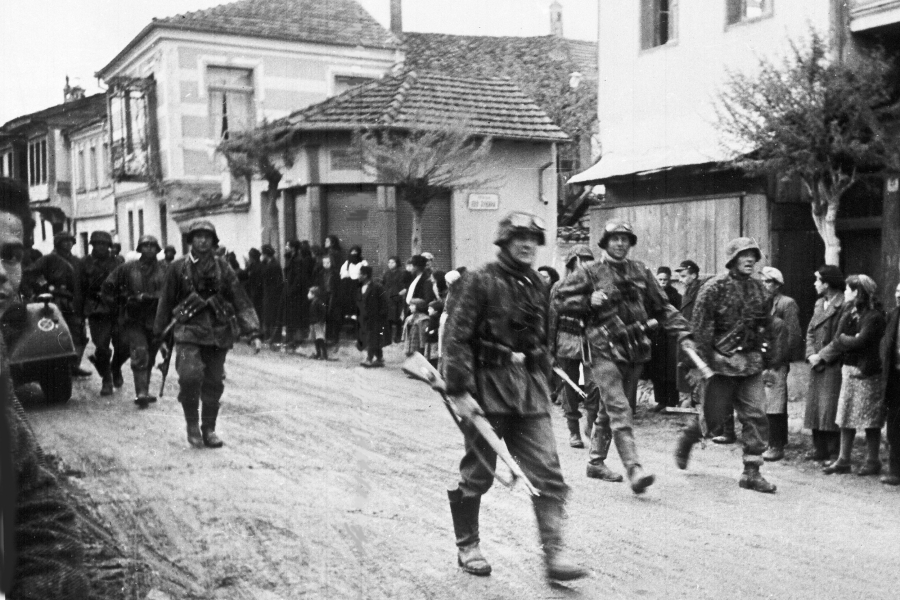
The exploitation was formalized in March 1942 through what became known as the Occupation Loan, an agreement imposed by Germany and Italy on the Greek government.
The German Occupation of Greece during World War II marked one of the darkest chapters in the country's modern history. Between 1941 and 1944, Greece was not merely occupied - it was systematically stripped of its resources, its economy destroyed from within, and its people driven to the brink of starvation.
According to the History of the Bank of Greece (Psallidopoulos, 2014), those four years led to a complete monetary and productive collapse, undoing the stability painstakingly achieved in the 1930s. The author calls it not simply a crisis, but "a descent into the abyss."
From the earliest days of the Occupation, the Axis powers - Germany, Italy, and Bulgaria - seized control of the country's economic machinery. The Bank of Greece was placed under foreign supervision, with commissioners authorized to dictate monetary and exchange-rate policies. The occupiers even attempted to circulate their own currencies in the Greek market: the German occupation mark, the "Mediterranean drachma," and the Bulgarian lev.
Despite efforts by the Bank's administrators to maintain some semblance of monetary stability, the occupation authorities drained the institution's reserves by demanding direct "financing." This practice, justified under the laws of war, effectively amounted to a forced loan to the Axis powers - money that was never repaid. The exploitation was formalized in March 1942 through what became known as the Occupation Loan, an agreement imposed by Germany and Italy on the Greek government. Under it, the Bank of Greece was obliged to cover, in drachmas, all the operational costs of the occupation forces.
Estimates of the total amount vary, but the debt is thought to have exceeded 3.5 billion drachmas at the time- an astronomical sum. As withdrawals from the Bank's reserves continued unchecked, Greece experienced a wave of monetary expansion that quickly spiraled into hyperinflation. Decades later, the Bank of Greece would revisit the issue repeatedly, reaffirming that this "loan" was in fact a coercive, unpaid debt owed by Germany to Greece.
While the monetary system disintegrated, the country's real economy was also dismantled. Agricultural goods, minerals, and raw materials were systematically seized and exported to serve the Axis war effort. Greece was further burdened with the cost of feeding and maintaining the occupying armies, as well as supplying their campaigns in North Africa and the Soviet Union.
The consequences were catastrophic. According to the Bank of Greece, the money supply increased by an astonishing 36,000 percent between 1939 and 1944. The value of a single gold sovereign rose from 1,000 drachmas before the war to 1.5 billion by its end. National income collapsed, and entire regions—such as Eastern Macedonia, Thrace, and the Ionian Islands—were detached and annexed to Bulgaria and Italy, depriving Greece of vital sources of production. Agriculture withered under requisitions, industry ground to a halt due to shortages of fuel and raw materials, and commerce was taken over by profiteers operating through the black market.
The monetary devastation reached surreal proportions. Hyperinflation rendered the drachma worthless. Between 1943 and 1944, new banknotes were issued at a dizzying pace: one million drachmas, then five million, ten million, twenty-five million, and, by September, even two hundred million. When German forces finally withdrew from Athens in October 1944, the vaults of the Bank of Greece were empty. People survived by bartering goods or trading in gold sovereigns, which had become the only trustworthy means of exchange.
Prices changed several times within a single day; the price of bread could double by evening. Wages lost all meaning. The country plunged into famine during the winter of 1941 - 42, a catastrophe that claimed tens of thousands of lives and reduced the population by an estimated 415,000. In the midst of this chaos, the Bank of Greece undertook a remarkable operation: the evacuation of its gold reserves. As recorded by Governor G. Mantzavinos, the gold- some 610,796 ounces - was secretly transferred from Athens to Crete, then to Alexandria, Durban, and finally London, where the Bank established a provisional headquarters in September 1941. From there, a small team of six employees managed Greece's remaining international financial affairs and laid the groundwork for postwar recovery.
When the Occupation ended in late 1944, Greece was an economic wasteland. The money supply had multiplied thousands of times, public finances were non-existent, and the new government had to issue 500-million-drachma banknotes just to keep transactions going. In November 1944, a radical currency reform was introduced: one new drachma was exchanged for fifty billion old ones. The reform halted hyperinflation, but the psychological and structural damage was profound. Trust in money had evaporated, the market functioned chaotically, and inflation remained high for years.
The Occupation did not simply destroy the economy- it shattered institutions, wiped out savings, and tore apart the social fabric. Small depositors lost everything, wage earners saw their incomes vanish, and most citizens turned to the black market to survive. The banking system was paralyzed, stripped of liquidity, and forced to operate under the directives of the occupiers.
Meanwhile, inequality skyrocketed. Those who had access to goods, insider information, or connections with the occupation authorities amassed wealth, while the vast majority sank into destitution. A grim expression entered the Greek vernacular to describe the time: "He ate bread with the pound." It became the bitter symbol of an era when gold was the only refuge of value—and survival itself was a matter of luck, privilege, or sheer endurance.
from Όλες Οι Ειδήσεις - Dnews https://ift.tt/qeoBiKX
via IFTTT